when i boarded the train to chongqing from chengdu two weeks ago, i had this sense of 舍不得, shěbùde, a reluctance to give it up. i had just found my niche, made myself comfortable, when it was already time to leave.
that said, i was excited for chongqing—my mother’s hometown and, i’ve long felt, one of the best cities in the world. it’s the only city in china to which i feel genuinely connected. chengdu has good food, but for me it has never compared to chongqing, the home of dishes like 重庆火锅 (chóngqìng huǒguō, the red-oil style of hot pot), 辣子鸡 (làzǐjī, fried bits of chicken nestled in a sea of red chilis), 重庆小面 (chóngqìng xiǎomiàn, the city’s signature noodle dish), and the recently popularized 毛血旺 (máoxuěwàng, a málà soup filled with duck blood and offal).
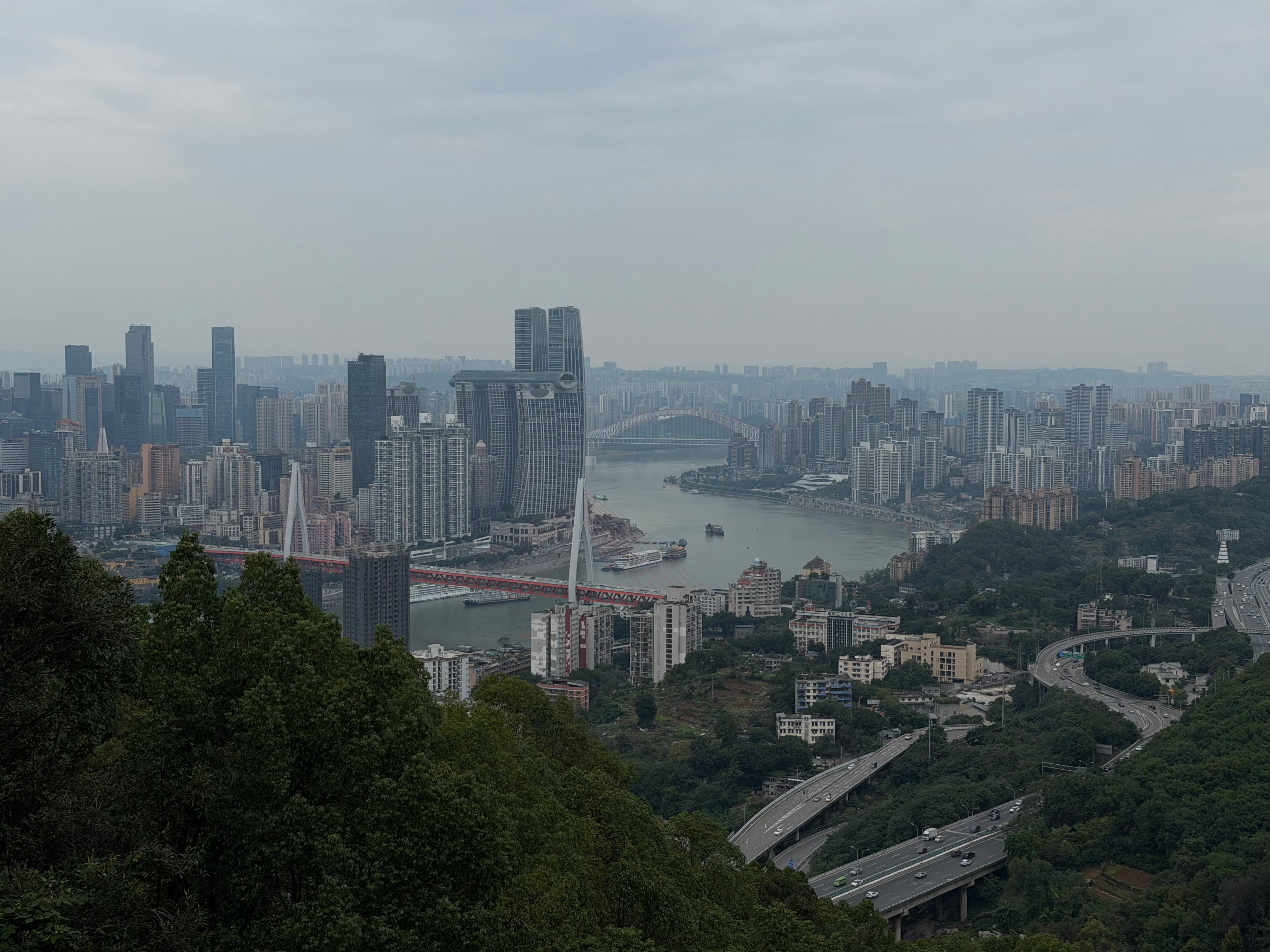
chongqing is a city of extremes. intensity of flavor and spice pushed to the max, a landscape of skyscrapers carved haphazardly out of a jagged mountain range, a character archetype that’s both quick to warmth and quick to anger. it’s high-resolution in its rawness, resisting easy description. sichuan is in large part defined by the contrast between these two major cities; where chengdu is relaxed and refined, chongqing is overwhelming and blunt-force. there’s an “anything goes” logic to it, with buildings and neighborhoods that feel more like wild overgrowth, organic and emergent, than a carefully designed garden.
my mom used to tell me that chongqing thrived as a city because of the topography. it’s surrounded by mountains, making it extraordinarily difficult to conquer historically, and it sits at the convergence of the yangtze and jialing rivers, acting as the eastern access point to the sichuan basin’s lush agricultural abundance. this geological formation meant that the land was both protected from the outside world and capable of supporting a massive population.
that same physical reality gave it its modern character during the second sino-japanese war when, in 1937, japanese forces pushed the nationalist government inland. chongqing was militarily defensible and logistically viable, so for eight years it became china’s wartime capital. the japanese bombed the city for years, with air raids becoming a daily feature of life. but between the shelters the chinese tunneled deep into the mountains and the fog that blanketed the city, making it difficult to strike accurately, the japanese were never able to capture it or the sichuan province.
many of the factories needed for the war had moved to chongqing in this period, and after the war, they stayed. chongqing is currently the largest manufacturing hub in the world for both cars and laptops, producing somewhere around a third of all laptops in the world, and this historical and present-day context has shaped its grittier industrial working-class identity. it’s one of four municipalities directly administered by the central government (so no longer formally a part of sichuan, though for most intents and purposes it remains deeply so culturally), along with beijing, shanghai, and tianjin.
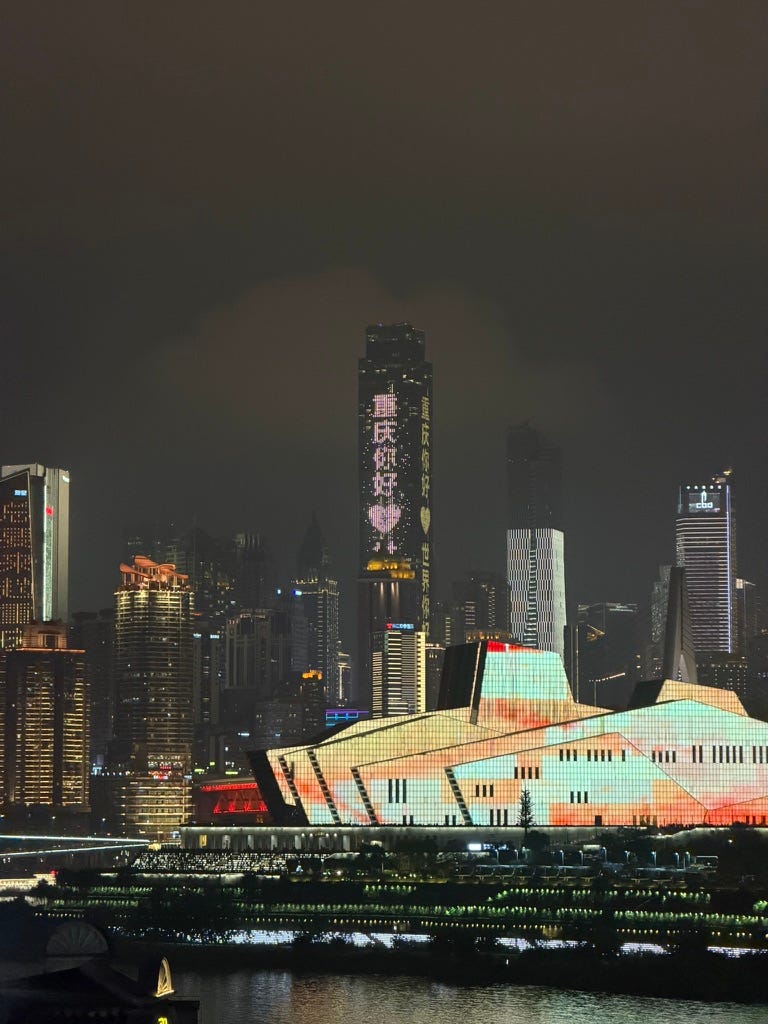
more recently, chongqing’s become tiktok-famous as the “cyberpunk city of china.” when i last came in 2019, the city had just kicked off its municipal led grid, running synchronized light shows across the whole cityscape of buildings to draw tourism. few of my friends who weren’t chinese had even heard of it; when i came with my partner at the time, his mom had asked if there would be running water.
six years later, this picture has transformed entirely. so much so, even, that i learned that an old friend from san francisco was in town at the same time as me. we met for hot pot the evening i arrived, and he told me that he had seen videos of chongqing on social media and wanted to see it for himself. another friend replied to my instagram story, asking if i was at the “world’s largest drone show” in chongqing; he had just seen it on his other friend’s story as well. the urban planning has been paying off.
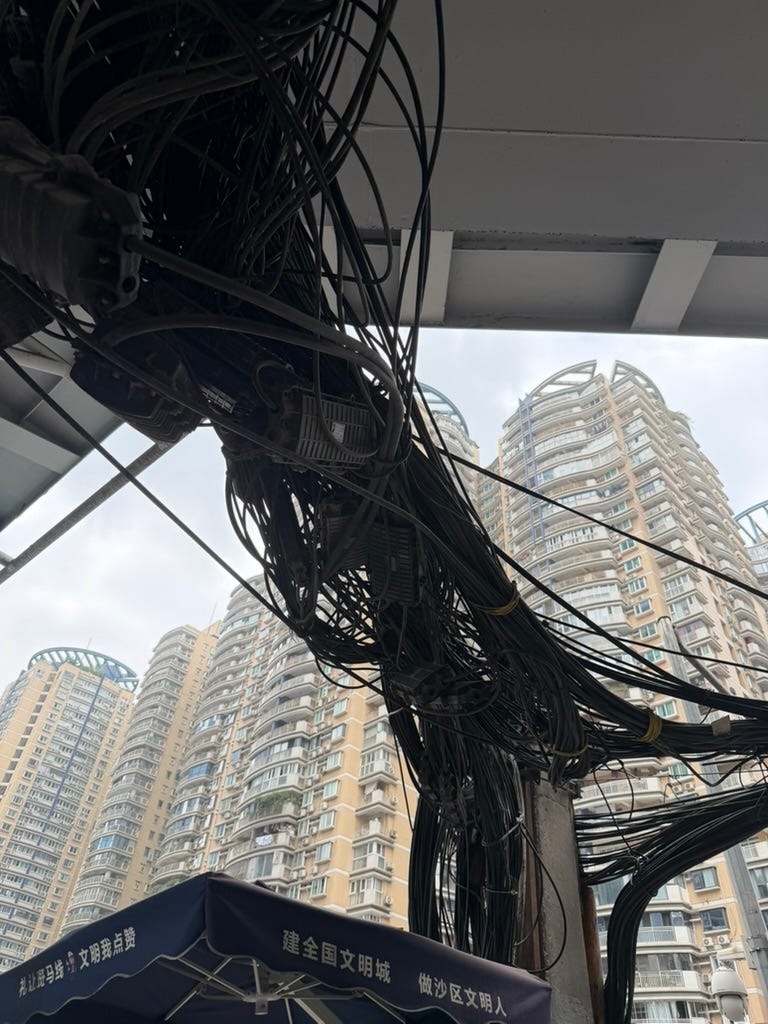
when tiktoks of chongqing as the “vertical city” first began popping up on my “for you” page a few years ago, showing the signature quirks of the city—skyscrapers you enter and exit at different altitudes, train tracks that run through buildings, chaotic winding stairwells and pathways that lead to unexpected places, the air raid shelters that once kept civilians safe from japanese bombers and have since become viral hot pot restaurants—i was shocked (and thrilled!). this place so dear to me was getting some recognition, at last.
i started off my time in jiefangbei, the densest and most touristy part of chongqing, where the vast majority of the hotels were located. i had been hesitant about choosing this neighborhood, unsure if i wanted to be amidst so much chaos, but claude and chatgpt had assured me that it would, at the very least, be convenient.
my hotel was piled into a vast skyscraper populated, confusingly, with several other hotels, all with different elevator systems and floors. my didi from the train station had dropped me off in front of the westin hotel; i ventured inside awkwardly with my suitcase, and they waved me to a back elevator to go down to the first floor, where my hotel’s lobby was. faiq, my old friend from san francisco, had happened to be staying at the westin and arrived half an hour late to our dinner because he got lost on his way out of the building.
the hotel that i had picked was domestic—my mom had always warned against chinese hotels, which in her experience typically had much worse and less consistent service, but i wanted to gather as much experience as possible. why come all this way to stay in a cookie-cutter american chain i’d experienced a hundred times? the boutique hotel where i had stayed in chengdu had been perfect, tasteful and cozy, a charming old soviet building with just a few floors that had been freshly renovated. i had gotten to know the faces of all the staff over my stay.
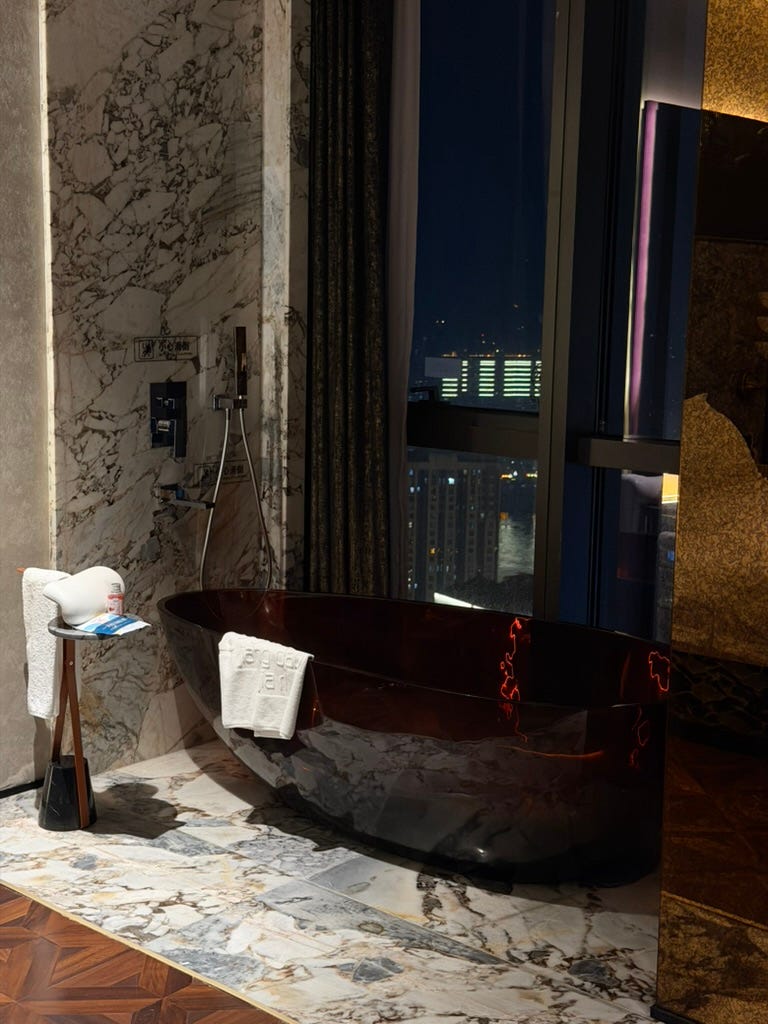
chongqing, though, was different. even perusing the hotels to book had revealed a gap in the market for what i normally sought. everything was, to put it bluntly, super tacky. i picked one of the least offensive options i could find, and when i arrived to my room, even knowing what to expect, i was taken aback by the gaudy maximalism. everything was cheaply marbled or lacquered, vaguely gesturing at some cursed hybrid between art deco and modernism. the room felt too big, like they hadn’t known how to furnish all that space. a transparent cherry-red bathtub sat ostentatiously in front of the window overlooking the city.
i decided instantly that i didn’t want to spend the full sixteen nights at this hotel. but where would i go? what if my next pick were somehow worse? my research about neighborhoods had been messy and inconclusive; there was only so much i could find online about how each area felt. i narrowed my options to three (e’ling park, shapingba, and changjiahui), then resolved to visit each over the course of the next week.
i spent the following days wandering through the city with this loose aim, frequenting sightseeing hotspots with all my devices in tow. i read deleuze and adorno and byung-chul han from cafes, journaled on mountaintops, edited photos at teahouses, and so on. unsure of what else to do with myself, i started to feel restless. it became apparent that the kind of social scene i had encountered in chengdu didn’t exist at all in chongqing, or, if it did, it wasn’t easy to find.
the longest i had ever spent on my own prior to this travel was two weeks in europe after i graduated from college. i was miserable by the second week. bored out of my mind and overheating in the unairconditioned airbnb i was renting in paris, i wondered if i should just go home early. solo travel had lost all its romance for me.
afraid that this time in china would be the same, i spent the month or two before i departed pitching all my friends to join. i was terrified, i think, to be by myself in the aftermath of this breakup. but of course no one else was in the middle of a life crisis, untethered from a job and a partner, and traveling to china was no small commitment. everyone was either grinding late hours at their startup in takeoff mode or interviewing relentlessly for new jobs, and so i came alone.
but perhaps in the intervening years since that post-grad trip i’ve changed, because i wasn’t doing nearly as poorly as i had feared. i passed the two-week mark, then three, and i didn’t want to die. brief interactions—a conversation with the kind auntie working housekeeping at the hotel, a few sentences exchanged with a girl who helped me order an apple-cinnamon latte at a cafe—kept me afloat, along with a few calls with friends back home.
i suddenly had so much time. there was nowhere i had to be, nothing i had to do, no one i had to see. i was forced to, for the first time in nearly a decade, be by myself. what do i want? this question, asked again and again, unburdened by external constraints, was surprisingly anxiety-inducing. i found myself sensing deeper internally, inspecting faint thoughts and emotions that otherwise would have been drowned out by the noise of other people’s needs.
the temporal expanse, undivided by structure, created space for randomness. many days were intellectually generative in a way i hadn’t experienced in years; a thought would flash from one domain to the next, lighting up connections, each of which would spiral out into many more. deleuzian deterritorialization into big tech-startup competitive dynamics into chinese governing policy into deontological ethics into technological determinism into llm architecture... and so on. i had the phantom sensation of neural pathways activating in my mind, spidering through dense interwoven conceptual webs. i would be standing on an escalator or eating at a restaurant and, all of a sudden, feel compelled to pull out my phone and dictate a voice note, a scattered mess of observations and thoughts and ideas that nonetheless felt significant.
this same space, though, was continually punctuated by waves of overwhelming grief i couldn’t predict. the first month after the breakup had been filled with logistics. moving out of two homes, disentangling finances, quitting my job, finding a new therapist, finalizing travel plans. there was a relief in escaping into productivity, something i could do, something i could control. when i wasn’t checking items off my to-do list, i was with friends. evenings were hardest; i avoided spending them alone as much as possible. in other words, i had compulsively filled every nook and cranny of time.
now that it was free, the emotions i had been keeping carefully bounded were, too, free to expand into their much larger container. anything could trigger a memory that would overcome me. i wept in didis, temples, grocery stores. the distance between intellectual understanding and lived reality was a chasm; it might as well have been infinite. the questions i had, the problems i wanted to solve—all of the answers, tidy and conclusive, had been computed long ago, but coming to accept them was becoming a circuitous task. i would build little sandcastles of knowing, feeling more sure of myself, before, lo and behold, they were washed right back into the sea.
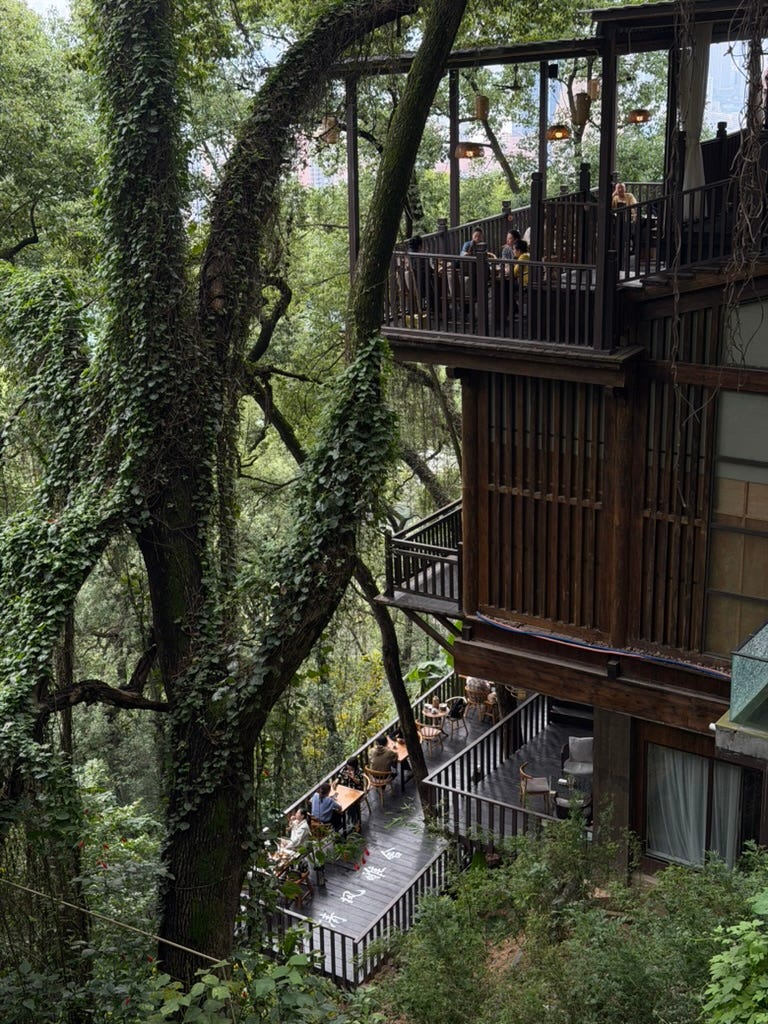
day by day, i began to despair in my search for a new hotel and neighborhood. e’ling park managed to be both swarming with tourists and pretty desolate in terms of walkability. shapingba, where my mom’s side of the family had all lived, was lively and vibrant with real locals, but the hotel options were dire and all clustered around aging shopping plazas.
when i arrived at changjiahui, my hopes weren’t high. yet another mall, albeit a nicer one that was neither exclusively international luxury brands nor sad run-down shops selling jeans for a dollar each. but as i wandered through the area, i became more and more comfortable. it’s relatively newly constructed, a showcase district featuring terraced levels, a riverfront view of the skyline, heritage sites and new builds coexisting harmoniously. i peeked inside the lobby of my candidate hotel and sighed with relief—it was quiet, lovely, fragrant. perhaps it was time to accept that my taste was simply too particular to be just anywhere.
i moved hotels just two days later. at the lobby desk during checkout, the woman asked me for a five-star review. i smiled politely and told her i’d write a review later. then, before i could react, she took my phone, opened it to the booking app, and marked everything as five stars, handing it back to me to write the review. speechless, i said no, i would do it later, and made to leave. she came out behind the desk to physically block me; she needed to take a picture of the five-star review, she said. after several minutes of back-and-forth, i was getting increasingly angry when she waved to her colleague to give me a stuffed rabbit in exchange for the review. the “bribe” only incensed me further—i refused and finally pushed past her to go. 太过分了 (tài guòfèn le); it had crossed a line. thank god i’m leaving, i thought.
the new hotel was not perfect, but it was perfect in every way that mattered: calm and comfortable, in close proximity to a wide range of restaurants that weren’t just street food (of which i had swiftly tired), with wonderful staff and a nightly delivery of dessert soup. i even had a couch, a luxury that i hadn’t had since the breakup.
it also happened to be right next to the part of the river where chongqing’s famous drone show happened. a day after i arrived, i got a text from the hotel to let me know that there was a surprise drone show that night. usually they were weekly, 8:30 p.m. on saturdays—i had watched the last one from the sky lounge of the westin, but backwards and from a far distance—but for some reason there was one that evening, and i could go watch it on the hotel’s rooftop.
and so i wandered to the roof, where the show had already begun. even through glass from a distance, it had been impressive, but here, so close to it, it was magical. all the people below me on the wharf and on the rooftop of the neighboring mall were frozen, eyes trained up at a night painted with thousands of pixels. it was like stargazing, the collective act of drawing meaning into the sky, except there was a raw physicality to it, too. the swarm of drones produced a loud buzzing, like a larger-than-life beehive. when the last formation ended, i lingered, watching the sparkling drones flit back home.
honestly, i hadn’t intended to see family in chongqing. most of my family is in the u.s. or canada as of the past several years, and the distant relatives left i had only even met once or twice. the one exception was my oldest aunt and uncle, but i’d rarely seen them in the past decade. i didn’t feel psychologically prepared for it, especially without my mom there as buffer. but i let it slip in a casual conversation with a cousin who had sent halloween photos of his kids, foolishly hoping to connect with him over his hometown and assuming he would keep it under wraps. by the next day, the whole extended family knew, and i was called to pay respects.
the visit came together with minimal input on my part, with my mom acting as a go-between for me and my aunt. i was willing to go wherever and whenever i was wanted. still, i hoped to get some measure of a schedule, what would be expected of me. i was told we would go to my grandparents’ gravesite to 扫墓 (sǎomù, sweep the graves), then pay a visit to my grandfather’s former apartment in the city. the logistics, though, were complicated. it was a two-hour subway ride from my hotel, but then we would have to call a car, and it turned out there were no addresses in that rural area. my mom wasn’t even sure roughly where it was.
“are there, like, coordinates? or can anyone point to it on a map?” i asked, mystified as to how i was supposed to book a didi to an unspecified location. apparently my aunt had always just given verbal instructions to cab drivers, telling them where to turn and where to stop; it suddenly made sense to me why didi still ran partly on dynamic-price rides rather than fixed-price ones. my mom warned me that finding a car back would be a problem, that it sometimes took hours from there. i was desperate to find an alternative (scheduling a ride in advance?), but, again, with no address, there was nothing to do.
after much deliberation to which i was not privy, a cousin’s son who had a car was unearthed, so he would take us. i was supposed to pay for everything and bring some cash as a gift for my elders. before i left the hotel, i texted my mom to ask, “should i plan to be there the whole day? or what’s the plan?”
“i think so,” she said. “just need to check if your 大姨 (dàyí, oldest aunt) told everyone. in this case, be prepared. anything could happen.”
“okay... ominous,” i replied, feeling vaguely panicky.
the long subway rides were oddly empty and calming, even with three transfers. i was finally starting to feel inspired to write for the dream machine again, after having tapped out, and the ideas were flowing so rapidly that i pulled out my laptop on the train and started drafting an outline.
when i arrived, my aunt and uncle were already there, but my cousin (technically my second cousin once removed, but, for simplicity) was not. i had forgotten how much my aunt talked and how much my uncle smoked. she immediately shepherded me to some nearby food carts and made me get some breakfast even though, i protested, i had already eaten that morning and wasn’t hungry at all. i gave up and ordered some 凉面 (liángmiàn, or cold noodles) to eat while we waited. my uncle sat under a tree at a distance, chain-smoking cigarettes.
my cousin finally arrived to pick us up, and after a stop at a flower shop, we made our way to the family land. i had thought we were just visiting my grandparents’ gravesite; it turned out there were three other graves i was supposed to sweep, so i bought four white bouquets, arranged simply and wrapped in paper.
when we got there, my mom’s other cousin—let’s call him my uncle—who still lived on the farm was waiting by the side of the road to greet us. it was raining, and he wore an umbrella hat strapped to his head (an ingenious invention, i thought) and knee-high galoshes. as i looked at the land, my memories from six years ago flooded back. this place, right, right.
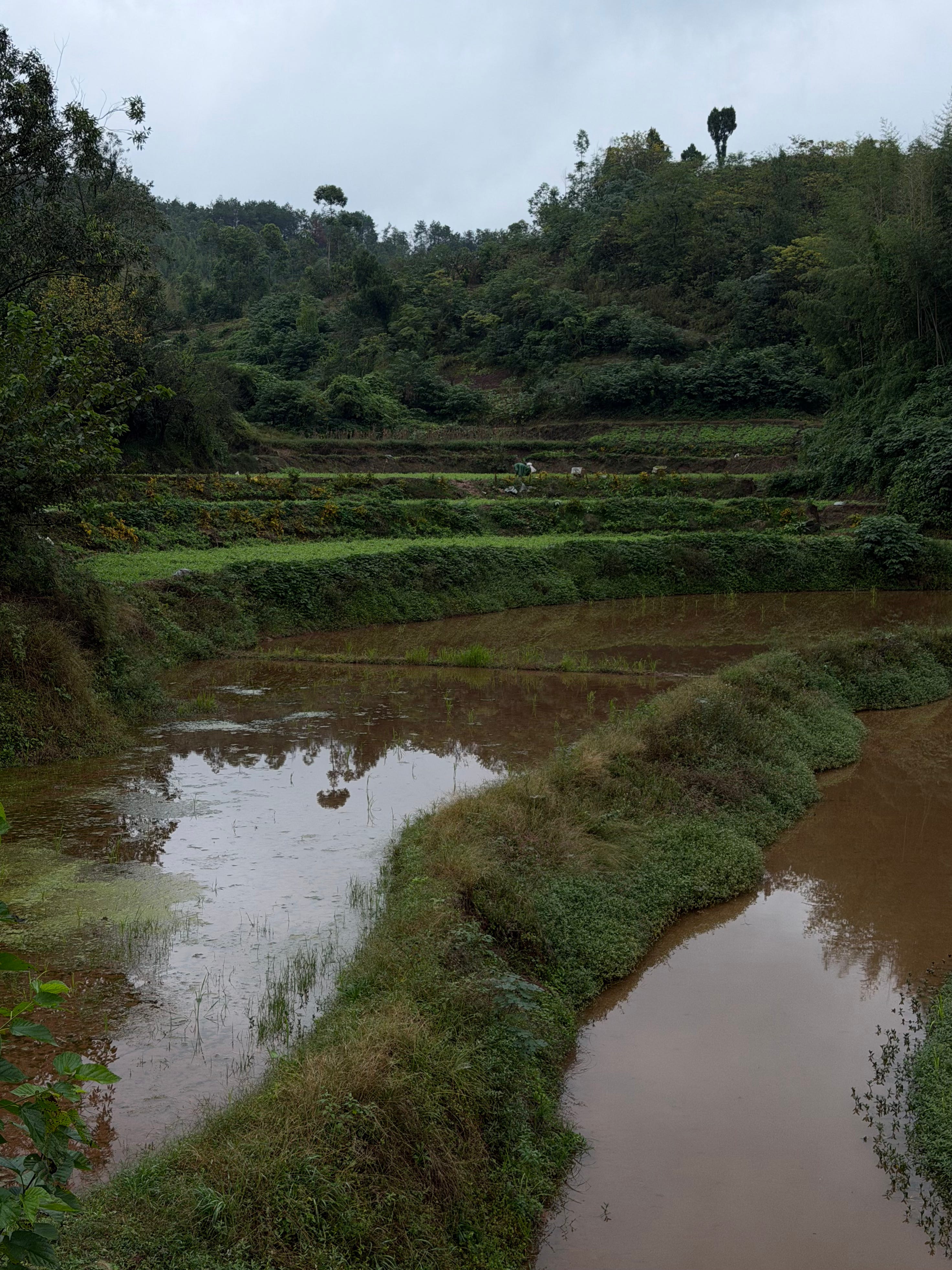
we wound our way down the path, past the terraced irrigation levels segmenting the hills, past the trees laden heavy with fruit. it was beautiful. i hadn’t expected it. i had last come in the summer, when everything was hot and sticky and brown, but in the mist this time of year, the verdant growth was picturesque, tranquil. even the crumbling farm structures had a grace to them.
eventually we stopped, and my cousin gestured up toward a hill. “we’re here.”
i blinked. i had remembered a hill, but there had been a path, if makeshift. all i saw now was a dense thicket of weeds, several feet high, covering a steep incline, with no path in sight. i was wearing white sneakers. i had expected some hiking, but climbing up some kind of wholly untamed vertical hillface in the rain was far beyond what i was prepared to do. but we had, at this point, collected a small troupe of people ostensibly related to me in one way or another. they all looked at me. i looked at the hill. “uhhh, okay.”
gingerly, i stepped up. the ground was soft and slick, mud that felt more like clay. there was, i noticed, some semblance of dirt steps beneath all the weeds, which was vaguely reassuring. i made my way slowly, slipping several times but managing to avert total disaster. thankfully, it wasn’t far—i hadn’t been able to see the graves at all from the path because they were hidden in the grass, but in actuality they were right there.
when i saw my grandparents’ grave, i wasn’t sure what to do. there wasn’t even really a place to stand in front of it, and the weeds had fully engulfed the site. it was a far cry from what i remembered, a simple but dignified resting place. my cousin helped pull aside the bulk of the overgrowth, and i knelt and placed a bouquet at the base of the tombstone. my relatives stared at me expectantly. the uncle in the umbrella hat said a rapid stream of sichuanese that i only partially understood; from what i could make of it, he was asking if i had a religion to invoke, if there were some christian rite to follow or prayer to say.
alas, the curse of atheism, i had none. i closed my eyes and focused silently on a wish for my grandparents. when i was done, i opened my eyes and nodded. everyone shrugged; they took some photos of me there, and then it was onto the next.
after three more graves, two additional treacherous hills, and many long explanations of how each of these people of whom i had never heard was related to me, i had performed my duty to the deceased. we joined my uncle, who had been sitting and smoking by the farmhouse. our shoes were caked in mud; my white high socks that i had bought at the mall the day before (i kept running out of socks) were streaked brown. my aunt used a brush by a well to start scrubbing off her sneakers, then prompted me to do the same.
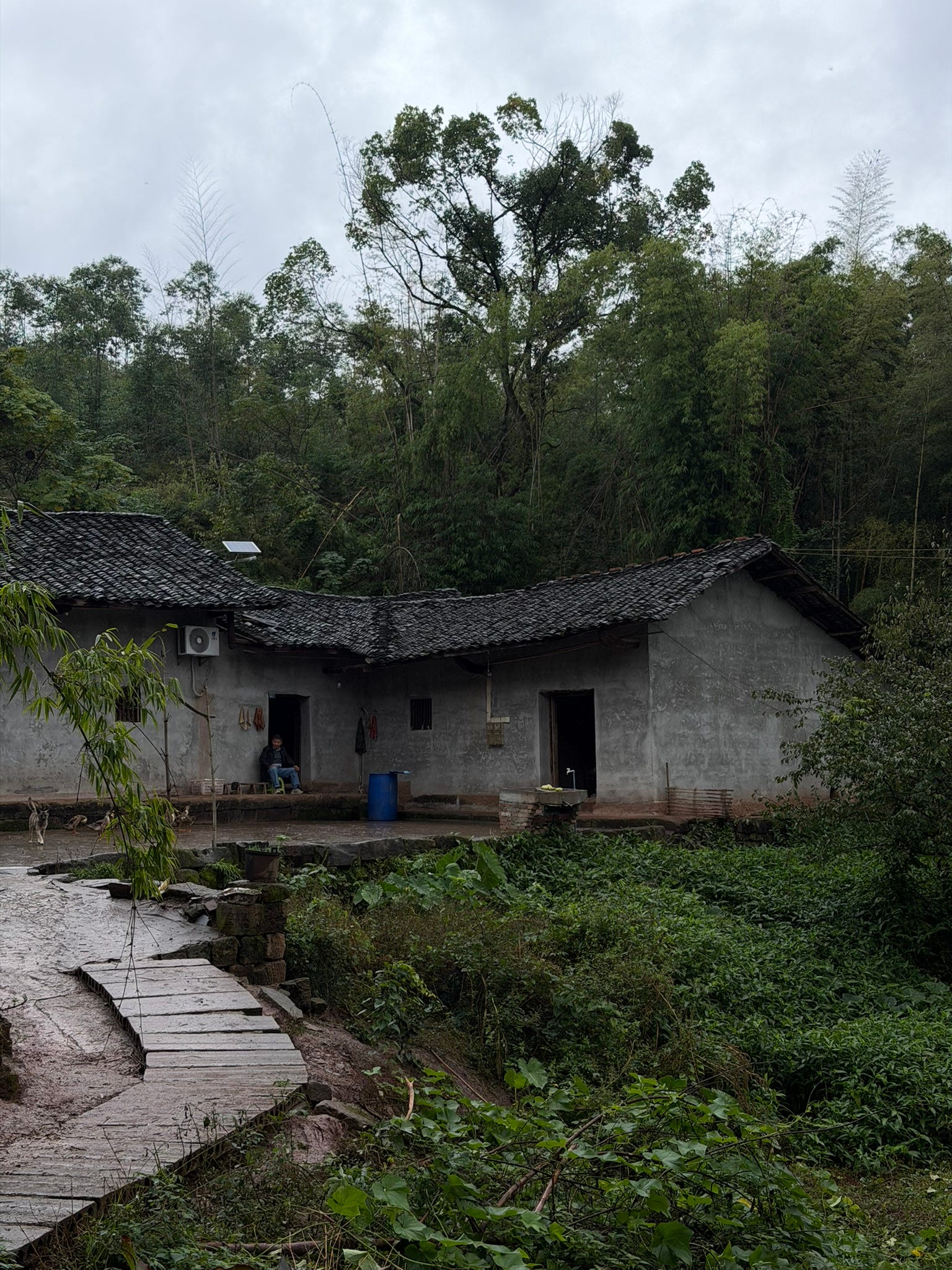
once we had cleaned up as much as we reasonably could, they walked me through the house. it had been in our family for generations, and it looked the part. the ground was dirt, and some of the walls were unevenly compacted earth, an adobe-like texture. the central section had been there for over two hundred years, the uncle in the umbrella hat explained. we peered into it. it was pitch-black, except for the light coming through the holes in the roof, covered hastily with plastic. he pressed a button, and a single fluorescent lightbulb wired to a flimsy solar panel lit the space.
here had once been a second level, he gestured. they had removed it for storage. there were some alcoves built into the room for storing foods, sweet potatoes and other root vegetables. i could smell the pigs that lived in the next room and held my breath.
they showed me into the kitchen, which had an enormous wok built into the cooking surface. my aunt asked how they fueled it; he said they used dried plant matter from the farm, since there was such an abundance of it. there was a trough of water under the sink—clean drinking water, brought into the house by the bucket.
we walked through the last section of the house. my grandmother, who passed before i was born, had built this part by hand. it was a bedroom now, with miscellaneous objects piled onto the ground around the bed. the uncle in the umbrella hat showed us his surveillance system, with cameras covering different angles of the yard with surprisingly high resolution.
my aunt told me stories from her childhood. she and my second aunt had been born on this land. by the time my mom was born, the family had passed it onto my great-aunt’s family and moved into the city, mainly visiting in the summers. it was a full day’s walk, nearly fifty kilometers. they used to line up outside the cafeteria at chongqing university with pails to collect the scraps after students finished eating, then bring them back to feed the chickens so they would have eggs. she still had the old ration slips from then: meat rations, grain rations, oil rations. she had saved them all.
we picked some oranges and peeled and ate them standing as my aunt and the uncle in the umbrella hat chatted for a while longer. all the houses on the adjoining land around us were empty now, apparently. it was a dying place, with only the elderly and children left.
when we all filed into my cousin’s car, i opened google maps and saved the pin.