
multiplicity
the many realities of chengdu and my foray into its underground music scene
it’s my last day in chengdu, and it’s finally clear after days of nonstop rain. the forecast had looked ominous every day the past two weeks, but reliably the rain clouds dissolved or sprinkled briefly before dissipating, until the very end. luckily, my only plans were to stay at my hotel, drink tea, and write, so, if anything, the weather added to the ambience.
the best way i can describe my feelings for this leg of the trip is 满足 (mǎnzú)—content, full to the brim. i came to chengdu with a particular set of idealizations and aspirations, and i’m leaving with many of them dashed, many satisfied, all sharpened with the fine-grained definition of reality.
what drew me to chengdu in the first place was music. the classic profile of chengdu is that of a cultured, slow-paced city, home of literati composing poetry and drinking tea riverside. in the 2010s, though, a new archetype emerged with the rise of sichuanese rap. i think i first heard about it with the breakout of higher brothers, a rap group that came out of chinese label chengdu rap house. the sichuan dialect is, some would say, uniquely suited to this style of music: brash and expressive, littered with snappy humor and vivid slang. for a brief period, a vibrant ecosystem formed around this center of gravity, an anomaly in chinese culture.
this era faded into the rave scene, centered in large part on .tag, a underground techno club opened in 2014 by hakkaellen. this subculture borrowed much more from cities like berlin: experimental, nocturnal, heavily queer, but with its own flavor, both in relation to the mainstream culture in which it was situated and the government under which it operated. but it, too, was stifled, with the closure of .tag earlier this year and more and more shutdowns of clubs around the country in recent years.
given the current political climate, i wasn’t sure what i would find when i arrived, or where to even begin to look for what i sought. on my last evening in tokyo, i was explaining my intention to the two guys i had met who lived in l.a. and worked in film. surprisingly, they knew exactly what i was referencing—a friend of theirs had made a documentary about chengdu’s party scene just two years ago, titled the last year of darkness. i made a note to watch it when i got back to the u.s.
my time in this city has been characterized by contrasts, the juxtaposition of manufactured and raw experience. perhaps the single most distinctive shift since i was last in china in 2019 is the total dominance of social media. it’s reshaped the physical world, with a shocking number of spaces seemingly designed entirely to be sets for photos and shortform videos to post. obviously this phenomenon isn’t specific to china, but what felt specific was the degree of it and what constituted acceptable social norms around it.
the hotel i booked was right around kuanzhai alley, a historic district of chengdu populated with qing dynasty-era buildings, so the first morning after i woke, i decided to look for breakfast in the area. it was 10 a.m. or so on a wednesday, and i worried if anywhere would be open, but it was so close that the walk was worth it either way.
when i arrived, it was total madness. the alleys were so dense with people that i could barely walk. everywhere i looked, people were shouting at me, handing me samples, waving me into their shops. nearly everyone was taking photos, making it nearly impossible to move. the storefronts all had exaggerated cultural stylings, big and flashy for effect. the immediate thought i had was that it was like they had turned this chinese historical site into a kind of disneyland, or las vegas. i was in a simulacrum of traditional culture, optimized for spectacle, the snapshot of having been there rather than the experience of it in the moment. a few days later, after grabbing a cocktail at a nearby bar, i walked through one of these alleys in the evening and noticed that it was much clearer, empty but for influencers in heavy makeup and full traditional dress taking videos of themselves with tripods and ring lights.
this category of experience kept repeating, in large part because (unlike tokyo) i had nearly no recommendations from friends for places to go. as a result, i would browse apps like dianping, all centered around photos and videos, for ideas for what to do. one afternoon i was searching for a laptop-friendly cafe and found myself at a coffee shop called wanderlust. on dianping, it had looked quiet, beautiful, somewhere 安静 (ānjìng) to spend an afternoon writing.
in real life, it was swarming with pairs of young girls in elaborate outfits, taking turns posing all across the garden and inside the cafe and photographing the other. many of them wore the kind of makeup favored on chinese social media platforms, with whitened faces and enlarged eyes, so heavily contoured that their bone structure was transformed on screen but uncanny in person. the drinks they ordered were props, carried around the cafe untouched for hours as they took pictures. as far as i could tell, i was the only person there just to hang out.
it feels petty to make this observation when the u.s. has its own instagram culture that doesn’t look quite so different. but, also, i don’t know. in the u.s., there are certainly influencer hotspots where people come take photos and videos, where it’s more important to be seen there than to be there. but there is still, at minimum, the pretense of the latter. i don’t know that i’ve ever been somewhere where the digital footprint so dramatically overshadowed the embodied experience of a place. maybe you could argue that the chinese take on it is more honest, more transparent about what’s happening. but it was difficult to not feel like it did, in fact, make it feel more hollow.
regardless, i was there, so i decided to sit and write for a few hours. after a while, a middle-aged woman came and tapped me on the shoulder. i took out my airpods. she asked if she could borrow my seat for a photo. taken aback (it wasn’t like i was in a particularly aesthetic corner of the cafe), i agreed and moved to pick up my laptop so she would have an uncluttered shot, but she gestured for me to leave it. i watched, baffled, as she and her friend took photos, pretending to type on my laptop and sip my tea.
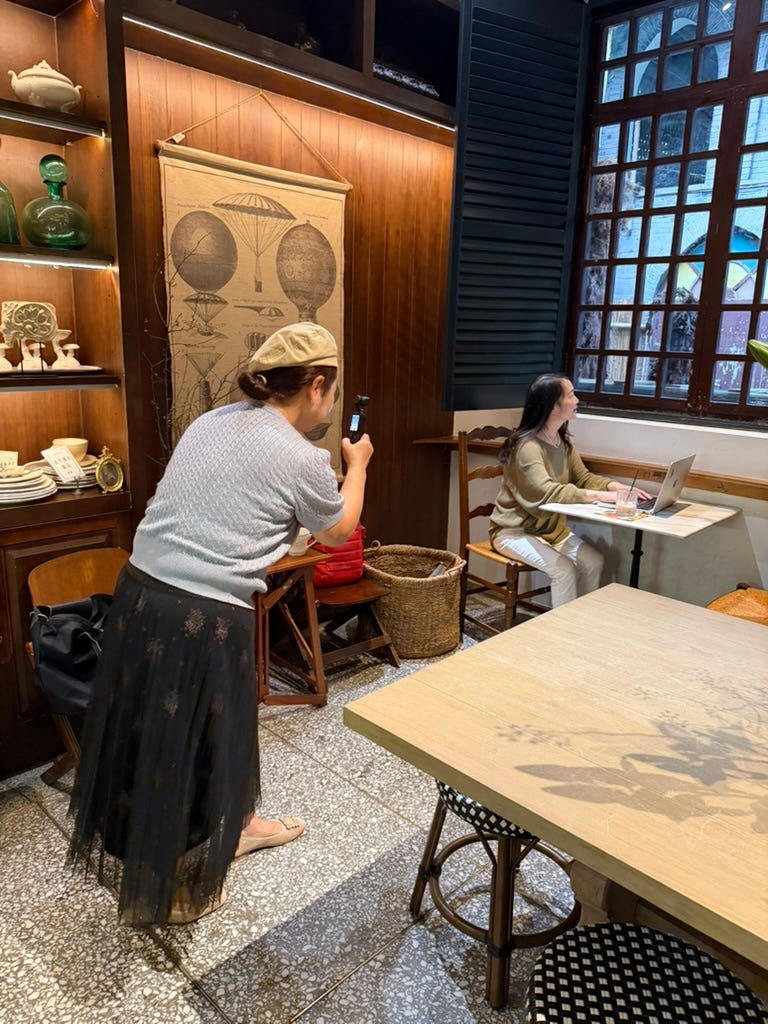
when they finished, i sat back and reopened my draft, only for them to return minutes later. “sorry, can we take a few more? we didn’t get any good photos.” i don’t know what possessed me to say yes again at this point, but i didn’t mind, really, and honestly thought it was funny, if bizarre. so i stepped back once again, and this time the woman operating the camera pulled out what looked like a gopro for a video shot, physically zooming into the scene before pulling back. it was the first experience i had of this kind but not the last, a rather chinese perspective on performativity on social media. if what’s important is the documentation, why go through the trouble of having the experience at all? it’s just inefficient.
the construct of a modern pride in chinese tradition (and the wave of 国风, or guófēng, a trend toward reclaiming and revitalizing traditional chinese aesthetics and crafts) has been a particular interest of mine the past several years. it feels like china’s first attempt at soft power that’s had some degree of global success. for a long time, the chinese elite tended to distance themselves from chinese culture, or at least see it as old-fashioned—to be cultured and educated was to emulate western etiquette and behaviors, own western luxury brands, and so on.
today, though, that picture is starting to look quite different. what might be termed “new chinese luxury” is increasingly everywhere—domestic fashion labels, contemporary interior design that reinterprets japandi with chinese characteristics, “new chinese” cuisine. most importantly, it’s targeted at and accessible to the upper middle class rather than just the wealthiest of the political elite and capitalist class, a sign of the rising tide.
this aesthetic is, frankly, much more to my taste because i am the target audience—i love the blend of zen minimalism and rustic countryside accents, the graceful fusion of modern and traditional. i wanted to see a lot of these places, partly to get a feel for how they fit into the broader landscape, partly because they’re just lovely.
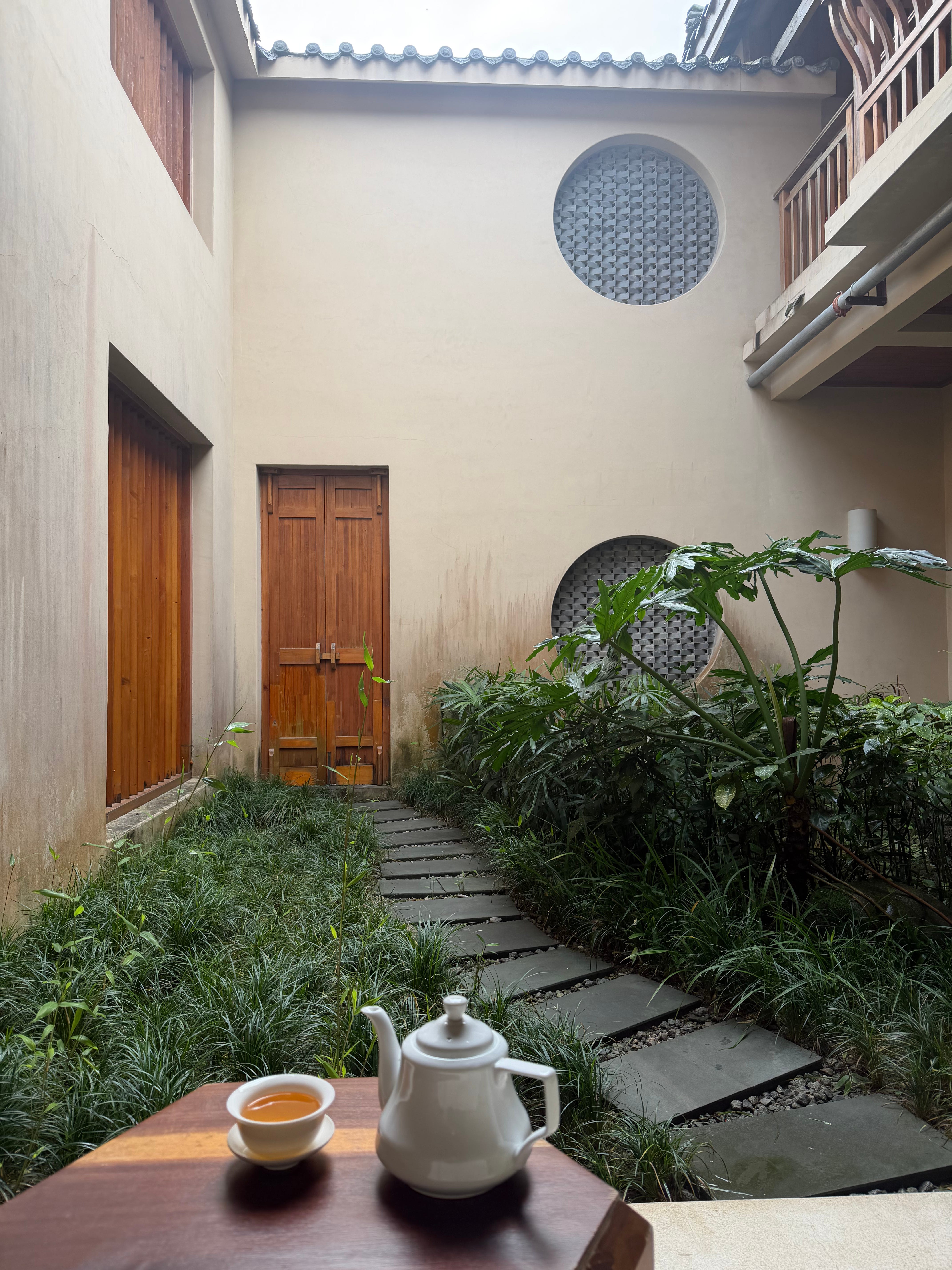
these kinds of spaces interest me because they work. they are beautiful, yes, but they are places where people are present, not simply backdrops. there is function as well as form. they define a cultural aesthetic that feels organic and emergent, though of course it’s its own construct as well. there’s a self-assuredness that feels new these past few years, evolving past imitating global trends or hawking chinese history and creating something that’s in conversation with both but also fresh.
still, contradictions abound. i went to see daci temple, a buddhist temple filled with chanting monks and people kneeling in prayer, only to find it nestled inside taikoo li, a massive luxury shopping complex. when i stepped through the gate to leave, i was faced with the balenciaga store. it was disorienting. it took me a moment to adjust, reconciling the sincerity of the religious space with the high-end retail space using it as a kind of backdrop. right next to the balenciaga store was a traditional chinese building, or at least it looked like it, except it was a fine dining restaurant operated by louis vuitton.
one notable quality to many of these places done well was the explicit intention of them. again and again, people told me about their goals to reintroduce chinese culture to chinese people. when i dropped by qiaoye teahouse, a gorgeous, tranquil courtyard in a quiet little neighborhood, i had just started reading a book when the manager came and asked if i wanted to come see a cultural exhibition that was just about to begin. surprised but intrigued, i agreed. it turned out to be much more involved than i expected—an intimate three-attendee workshop, with three “teachers,” where we kneeled on floor pillows in a square and tasted different methods of brewing tea in a proper tea ceremony, learning about their ingredients and their health benefits and the history behind the practices.
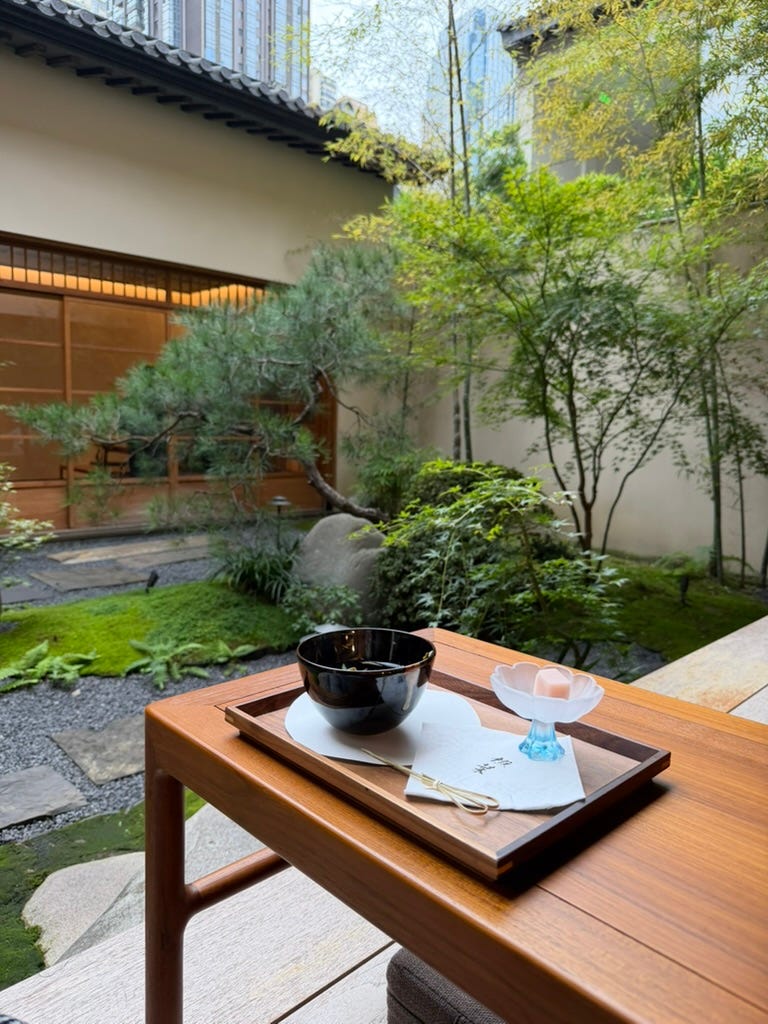
it was so different from many of my other experiences that i couldn’t understand how they were resourcing it. maybe they had received some kind of government grant for promoting traditional culture, or the practitioners were volunteers? or perhaps it was simply marketing for the tea house, but it felt so substantive that that was difficult to imagine. either way, i was appreciative. the ritual of it was beautiful, and the intention was genuine, and it made me wish there were much more of that.
like i said, i’d come for the music scene, so i kept tabs on the instagram accounts where venues would post their events. once .tag shut down in august following new regulations requiring businesses to close by 2 a.m., it stayed alive in the form of pop-up parties. luckily enough, there was one on saturday while i was in town. but before that, i wanted to check out two spaces also owned by hakkaellen, hakkabar and yitong, to get a vibe check on the social atmosphere, and so i went on my own friday evening.
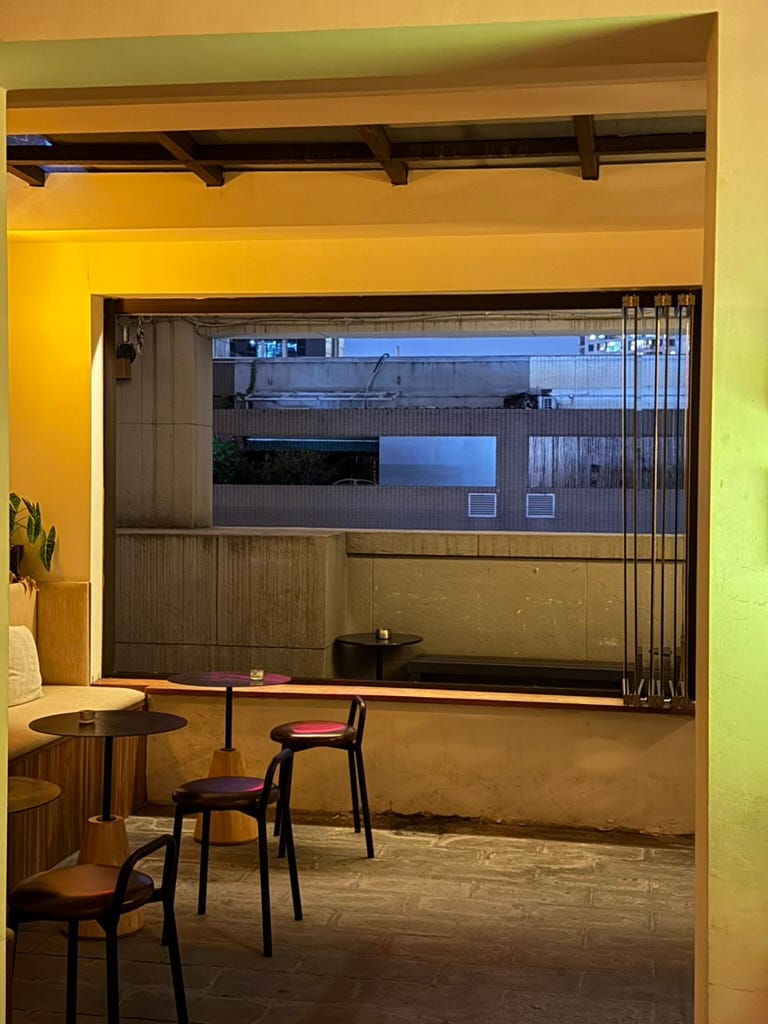
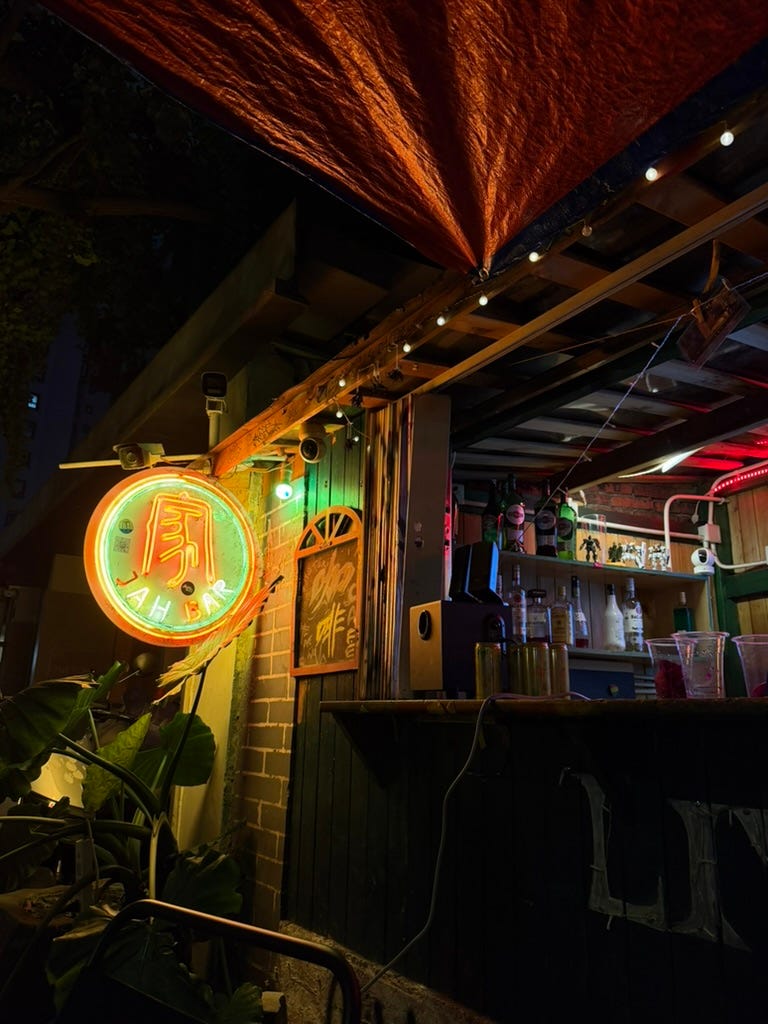
after a drawn-out ordeal wandering lost through a sprawling business complex searching for the right elevator (i keep having this problem everywhere), i finally found myself at hakkabar, an open-air bar on the top floor of the building. it was still on the early side, about half an hour after opening, and it was empty but for the bartender. i perched at the bar and started chatting with her. let’s call her n. originally from chongqing, just an hour or so by high-speed train from chengdu, she had bounced around different cities across china for years.
it made total sense that she was a chongqing native (coincidentally my mother’s hometown)—there was an immediacy to her emotional expressiveness, an open-book familiarity that instantly felt safe to me. she was new to the job, about two months into it and just six months into living in chengdu. i asked if she had liked shanghai, where she had lived most recently, and she shook her head vehemently. “i hated it! i hate capitalism,” she said, and i laughed. apparently i had come on a good night; there was a party that evening at yitong, a send-off for a girl about to move to berlin, so a lot of people would be there.
as we spoke, more and more people filtered into the bar, and n became frantically occupied with her work, so i talked to other people for a while: a guy from chicago who had been in china for the past six months doing an intensive mandarin course, one of the djs performing that night (a remarkably chic man from montreal traveling china with his girlfriend, who was playing the b2b set with him), a lovely romanian girl who lived in berlin and had similarly ended an eight-year relationship a year or two ago. the crowd was unexpectedly cosmopolitan, a mix of chinese natives hanging out with friends and going on dates and foreigners from countries around the globe. it was a relief to be having full-fledged english conversations again for the first time since tokyo, the expression of thought no longer compressed into what i could effectively communicate in chinese.
after an hour or two, another girl—i’ll call her p—came to start her shift. she was clearly much more experienced, and n, overwhelmed by the flood of incoming demands from the clientele, clasped her hands together in relief when she saw her. p waved her off to take a cigarette break, and i ordered a gimlet from her instead. we began to talk. i was shocked to learn she was only twenty-one; she had been working at hakkabar since she was seventeen or eighteen.
p’s life story unfolded. she was from guizhou, and in her teen years, she was diagnosed with bipolar disorder. her family, unsure of what to do with her, sent her to chengdu to get treated and to learn japanese, ostensibly so she could attend university in japan later. alone in a strange city, she successfully cured her bipolar disorder, but then the money for school never materialized, so there she was, working. she asked me about what i did for work and where i had gone to school, and when i told her that i worked in tech and went to columbia, she gasped. i was mildly embarrassed to so neatly fit this particular profile of privilege; she saw software engineering as an impossibly difficult, advanced job (i assured her it was not), and columbia was a place she had seen in movies and tv shows, more myth than reality.
i was curious about her, what she wanted out of life. she didn’t like chengdu. she felt trapped and desperately wanted to go somewhere, anywhere, else—australia, germany, wherever. she wore a world-weariness that struck me; her life had already been so difficult at such a young age. as is common in china, she dismissed a lot to fate. “ah, well, maybe in another life i wouldn’t have been born poor.”
“okay, fair, but also: you are a baby,” i objected. “your life isn’t over. you have so much time.” it turned out she still harbored hopes for a scholarship so she could go to school and not be locked forever into this category of job (the pay was, unsurprisingly, abysmal). she was obviously smart and capable, and it felt like it would be an enormous shame for her to have resigned herself to a life she didn’t want at twenty-one.
talking to others later, i discovered that, as you might expect, p’s story wasn’t unusual. many of the conversations i had centered on money, financial means and socioeconomic background. this space attracted people who existed at the margins: the economically precarious, the queer and non-conforming, the politically radical. unlike increasingly many of these kinds of places in the u.s. today, it wasn’t just alternative in aesthetic—it was grounded in class realities that, sobering as they were, had woven together a tight-knit community.
n came back from her cigarette break to staff the bar, so p dragged me over to yitong, the hybrid vinyl shop/cafe/bar a few doors down where the party was happening. she introduced me to the girl behind the dj booth who was moving to berlin for school, along with two other girls, k and m. they were super warm and, in fact, had spent a lot of time in new york, going once or twice a year to party at clubs like the good room until the recent political environment had made it untenable. both were chengdu locals who had been circulating in this party scene for most of the past decade—one worked in college admissions consulting, while the other was a project manager at an incubator.
we drifted back to hakkabar, where we took shots together. the big rush had eased, and n joined us, offering me her drink to share. k told me about the evolution, then dissolution, of the lgbt nightlife scene in chengdu. it had bloomed for several years starting in the 2010s, “a golden era,” before increasing pressures from the government led to its rapid dismantling the few years following covid. there was a time when they had been able to live openly, unencumbered, at least relatively speaking. that had ended. what was left was what was there: much smaller, more scattered, forced back underground. m told me about a book fair the community had organized more recently; it was shut down without explanation. even as i was there, the police came to tell n that they had to turn down the music. it was 10 p.m. on a friday, and the music wasn’t particularly loud or disruptive in the first place—the vibe was laidback and chill, and everyone was sitting and talking, not dancing—but she immediately complied.
i mentioned the last year of darkness, the documentary the guys in tokyo had referenced, and k immediately lit up. “she’s in it!” she exclaimed, gesturing back toward yitong and the girl who had been dj-ing. apparently she was one of the main protagonists of the film. later that evening, i would meet ben, the director, who had been living in china for ten years now.
what strange serendipity, to have been told of a movie by some american guys in a bar in japan and then run into the people who made it a week later in china. after the tea ceremony at qiaoye teahouse, the host, who was part of a branch of the wenshu monastery, had kept telling me what 缘分 (yuánfèn), for me to be there at that time and place. a perfect alignment of circumstances, a destined crossing of paths. that sense of the mystical has kept permeating this trip, week after week.
they were about to close up at hakkabar, and everyone migrated to yitong, where supposedly people had started barbecuing. i wasn’t sure what they meant. it turned out that the tables out front were fire pits, usually covered. people sat in circles around them while one woman managed the grilling, a vast array of skewers and aluminum trays of meats and vegetables splayed out around her. n told me that she was the owner, ellen. it wasn’t an environment i’d ever really experienced on a night out—homey, communal, all boundaries made porous. i couldn’t tell employee from customer; there wasn’t the compartmentalization of personhood into rigid roles. it felt like community in a real, real sense, not the corporatized, value-extracted form touted by businesses in the u.s. we sat there, talking, until i realized i had lost track of time and it was nearing morning. i bid my leave, hastily adding the people i had liked most on instagram and wechat.
on the car ride back, i kept thinking about the evening. it’s funny to think of how much effort the chinese government has put into promoting “chinese culture” by one narrow definition—real and beautiful, but also sanitized, mythologized, traditionalized—and stifling it in these others, when, to me, the multiplicity and the contradiction is what makes it interesting. a place like yitong is special, and it couldn’t exist in the u.s., but part of what makes it what it is is precisely that it exists in this complex environment. to be metabolized into the mainstream, to be reified politically, is also to be professionalized and stripped of unsightly truths.
the next morning i had had a chinese class scheduled for four hours after i went to sleep. i missed it entirely, bleary and hungover in bed. the .tag party was that night, and i had been hoping to meet these new friends there, but, alas, it was not to be—i left the hotel at midday only for the emergency sustenance of wonton soup before retreating back to watch tv in bed the rest of the day.
n, in particular, stood out as someone exceptional. we went out a few more times, with m and k and then again with l (the romanian girl we had met), and over the course of these nights, my understanding of her grew deeper. she identified as an anarcho-communist, scathing toward western leftists and chinese billionaires alike. at the age of thirteen, she had taken to the streets with tens of thousands of others after a scandal of police misbehavior had invoked massive protest. it turned into a riot, with protestors setting several police cars on fire, a nearly unthinkable act today. the incident was a huge political awakening at a formative time; she remembered an adult asking her how she felt, what she thought, about it and that shifting her whole worldview. no one had ever asked her opinion about the world around her before.
she studied history in college before dropping out, and we bonded over philosophy, which had been her second choice of major. i told her i had been reading deleuze and guattari’s a thousand plateaus lately, and she pulled out her phone to show me her current reading, anti-oedipus, translated into chinese and hosted on someone’s notion site. i recommended the dispossessed as one of my favorite speculative explorations of anarchism. had she heard of mark fisher? she had and loved him—not just capitalist realism, but his unfinished book acid communism. these works are, on some level, part of a leftist canon, but it was rare enough for me to find anyone in brooklyn who had read them in the wild—i could scarcely believe i was encountering it in this entirely happenstance meeting in china.
she had worked a wide range of jobs—working with ngos to support 留守儿童 (liúshǒu értóng, the distinctly chinese phenomenon of children left behind in rural villages while parents went to go make a living in cities), teaching in remote areas of yunnan, helping heroin addicts through nonprofit work. she wanted to find more work in this vein now, maybe working with the homeless. she yearned desperately to be able to fight, to be a part of a revolutionary movement to build a more just world. but she despaired of that possibility in china; the real fight was in southeast asia now, she said. countries like myanmar, nepal. china was too much like the u.s.
beyond all of that, we just vibed. she was 大方 (dàfāng), generous and open, carried by an easy confidence that was warm rather than alienating. she shared everything: drinks, cigarettes, snacks. she was daring and unshy, the opposite of the reflexive self-consciousness so common to people i knew. speaking to her, i admired the clarity of her beliefs, the ferocity of her spirit, when these same impulses in me were muted, wrapped in caveats and cynicism, for fear of looking foolish or naive. she knew what mattered to her and wasn’t afraid to speak without qualification. i had become so practiced at hedging, presenting every position as nuanced and provisional, that i’d forgotten what it was like to just be direct.
when i said goodbye, it was brief but weighted. i hugged her tightly, and neither of us knew quite what to say. some of the other girls, at least, i would likely see again—k and m promised to look for me the next time they were in new york, and l would likely be in chongqing or dali later in my travels. but n had never left the country, and i didn’t know when or if i’d be back in chengdu. in the didi back to my hotel, i messaged her on wechat, telling her that i was grateful to have met, that she was the coolest person i had encountered in a long time, and that i hoped we’d meet again someday.